DOLLY, DIVAS, & DIVINITY
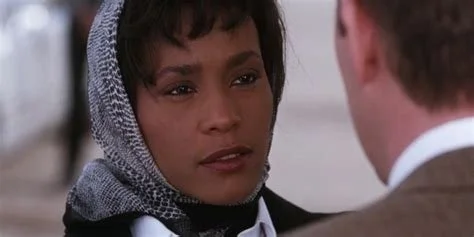
A young starlet arrives at an airport tarmac, entourage in tow. Inconspicuous and chic, she’s dressed how one may imagine a starlet to travel: A long dark trench coat over impeccably tailored casual black pants and a collared white blouse that shows a sliver of bare skin. Except for a curl of bangs, her hair is swept back in a patterned white and black scarf, recalling old Hollywood and the likes of Monroe or Hepburn. She looks comfortable yet stylish enough to be captured in an unanticipated photo. She removes her dark sunglasses to reveal a beautiful face blushed with rouge. Mascara tinged lashes frame her deep eyes. The starlet approaches a man in a drab brown suit. One arm hangs limply at his side while the other rests angled into a sling. He is clearly her unequal. This is to be forgiven since he’s the assigned love interest. There is a fondness between the pair as they chat about nothing before bidding goodbye. The drab suited man watches the starlet walk away and ascend a flight of steps into her private plane. He remains fixed, awaiting her final departure. The plane’s wheels begin to spin, moving slowly across the tarmac. The starlet looks longingly, wistfully, at the man through the window. As she gazes a powerful voice sings A Capella: “So I’ll go / but I know / I’ll think of you every step of the way.”
“Wait,” she yells and the plane halts. The flight of stairs drops back down and out comes the starlet—who of course is Whitney Houston—running, as the singing voice—also Whitney—is joined by a piano. She races to the man, the unlikely Kevin Costner, who embraces her in a kiss at the chorus of “I Will Always Love You.”
By second grade I was intimately familiar with The Bodyguard as was much of the world. Released two years before my birth in 1992, the film managed to catapult Whitney Houston’s pre-existing stardom to unprecedented heights. The movie, a thinly plotted thriller-romance, is anchored by a charismatic Whitney who, in a semi-meta performance, plays a famous singer who is stalked by an obsessive fan. Its success was indebted, in no small part, to the soundtrack and her chart-topping rendition of “I Will Always Love You.” Nearly a decade after its release, the track still appeared in regular rotations on radio airwaves.
I was ignorant of the song’s true origins when I first saw Dolly Parton perform it on television as a child on some awards or talk show. “She’s singing Whitney’s song,” I observed in near condemnation.
“That’s Dolly's song,” my mother corrected me.
Like everyone I knew of Dolly Parton (were we not all on a first name basis with her?) Through some sort of cultural osmosis I had absorbed her image and intuited significance from the height of her blondness and the twang of her southern accent. My mother offered frequent reminders and reproaches of white stars whose success was indebted to black music by covering songs and in the biting of black style. Her usual targets were the overplayed—to her ears—Elvis Presley and the Beatles. It wasn’t often that I heard the inverse to be true. And for a white country singer to do something worthy of Whitney Houston was intriguing.
“Dolly is bad,” my mom continued.
Later I would learn about the varied roots of American music genres from hip hop and R&B to jazz and blues to gospel to rock, folk and country as a complex hodgepodge that drew from enslaved African peoples and their descendants, native and indigenous cultures of North America, Caribbean countries, influxes of immigrant groups, and the many working poor. These foundations provided fertile ground for the intra- and inter-cultural exchanges in music that would allow for shared repertoire between artists of seemingly distinct different genres like Whitney and Dolly in the form of covers, collaborations, samples and interpolations (such as with Dolly and Kenny Rodgers' "Island of the Streams" melody heard in Pras and Ol' Dirty Bastard's "Ghetto Superstar.")
Though the history of popular music in the United States can't be reduced to a tidy emblem of the melting-pot ethos narrated to children in elementary school. The commercial record industry arose in a Jim Crow landscape and mirrored the violently stratified social world of the United States. Black artists were relegated to "race charts" (later, R&B) which made it more difficult to cross over to top 40 charts. (My mother recounts that during her childhood, black radio stations stopped playing at a certain hour.) Despite the ballooning popularity of genres like doo-wop and rock that were pioneered by Black performers and musicians, some white artists and the labels behind them found greater financial success than their Black peers, some of whom dwindled into obscurity. Hence my mother's annoyance with Elvis and the Beatles—who had the added offense of being British—both of whom she also confesses to enjoy.
Country music in particular has maintained a veneer of whiteness over the decades. In a seminal essay on Dolly Parton, sociologist and writer Tressie McMillon Cotton describes the genre's packaging "as the nation’s only authentic voice of the white working class." It retains this narrative of red solo cups, simple (if not downtrodden) living, and redneck pride while its stars amass wealth. And one can be big in country but not world wide (though trends point to growing global popularity) emphasizing its insider nature.
Forays into country music from nonwhite artists like Beyonce and Lil Nas X are treated as interventions met with skepticism and outcry, breakthrough anomalies (such as with Charley Pride), or asides to the traditional "true" nature of country music. It's been extensively reported that Dolly modeled her appearance after the "town tramp" of her small rural Appalachian hometown. The blond light-eyed white trash persona was also crafted with an audience in mind—one primed to be endeared to a pretty young woman of humble, i.e authentic, origins. And who could fault her? Image is a useful vehicle to carry a woman to the masses. Though Dolly had proven herself a savvy songwriter, it wasn't until she secured a spot on country titan Porter Wagoner's TV show in 1967 that her career saw real traction. Her first solo album Hello, I'm Dolly, revealed the jig upfront.
"Just because I'm blonde don't think I'm dumb / because this dumb blonde ain't nobody's fool," she croons on the plucky "Dumb Blonde." She performed the song on The Porter Wagoner Show in her debut as his new onscreen musical partner. Dressed in a sleeveless fuchsia dress, matching pink lipstick, and with her eyelids heavily dusted blue, she sings confidently, weaving in melodic snickers in time with her lyrical punchlines. "And you know there's one thing that this blonde has learned," swapping the original line "blondes have more fun" she offers instead,"blondes buy more peroxide," before breaking into a bright smile. In the two-minute performance she glides from disarming enchantress to scorned no-nonsense lover to winking vixen, staging the persona she would cultivate for six decades.
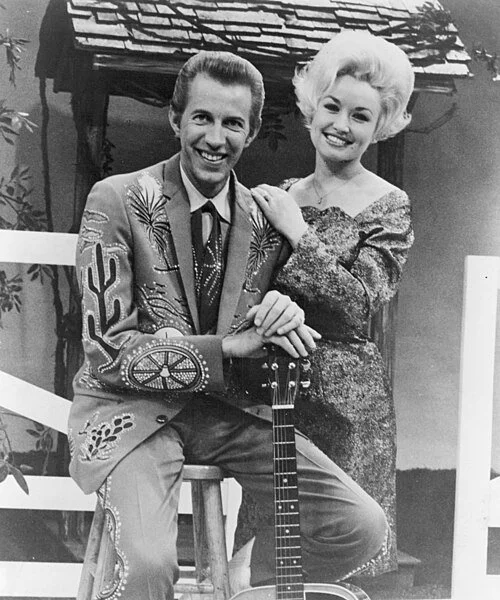
Dolly and Porter Wagoner in 1969.
Credit: Moeller Talent, Inc. via Wikimedia Commons
"[S]he just took my song that I wrote about the Porter Wagoner days and had a couple of hits on it myself, but then she took it all over the world," Dolly said of Whitney's "I Will Always Love You" cover shortly after the latter's death in 2012.
Penned as a farewell to Wagoner and their tenuous partnership, the song appeared on Dolly's 1974 album Jolene. The single and the title track gave her her first taste of mainstream recognition. By the late seventies, Dolly was an undisputed country star known to non-country listeners if not by her music than as a glitzy enigma. Her biggest commercial crossover came with a starring role in 9 to 5 (1980) for which she also wrote the accompanying soundtrack, featuring the eponymous lead single. By the time she rerecorded "I Will Always Love You" two years later for The Best Little Whorehouse in Texas she was a household name in the US of A. Dolly was reigning country diva supreme with her crown of platinum blond, teased as high as her soprano range.
A few years after Dolly's mainstream breakthrough, Whitney emerged with her own record-breaking debut in 1985. Though the album, along with her sophomore follow-up, were billed as R&B, they were ostensibly pop. Some black listeners were skeptical of Whitney's stratospheric rise and her commercial sound. It's difficult to comprehend how one could hear her belting "You Give Good Love" as anything less than soulful and God forbid a woman wants to dance to a synth-driven beat with somebody who loves her, but her popularity prompted a boycott among spearheaded by Al Sharpton, culminating in the young star being booed at the 1989 Soul Train Awards. In fairness to her critics, famed A&R executive, Clive Davis—credited with signing and overseeing Whitney's first (and subsequent) album—reportedly demanded that she not sound too black. In a strange subversion that echoed label execs of the fifties, Davis sought to minimize Whitney's race, sanding down rhythmic edge in favor of power ballads, while also leveraging the marketability of her blackness.
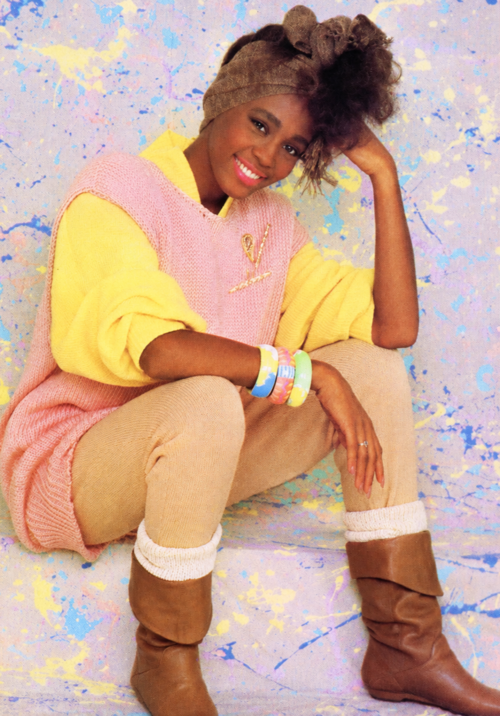
Credit: Steve Prezant, 1985, via Wikimedia Commons
The notion that she was a sell-out or a hollow construction from a record label wounded Whitney. A daughter of well-known gospel singer Cissy Houston, Whitney had forged her talents in the church. Her musically connected family in Newark, New Jersey included her cousin, the legendary Dionne Warwick, with whom she toured as a teen. On I'm Your Baby Tonight, released a year after the Soul Train Awards embarrassment, she tapped future Island Def Jam CEO L.A. Reid and R&B extraordinaire Babyface. Many of the songs on the album hears her flexing vocal runs over new jack swing. I'm Your Baby Tonight also holds Whitney's first production and arranging credits, evidencing her wresting creative control after two hit records that proved her money-making status. With The Bodyguard soundtrack Whitney achieved two major feats: She attained status as a viable actress and also further unified her split public image.
During Whitney’s rise, Dolly released an eclectic slew of albums following her cross-over success with "9 to 5." Though most were generally well-received, the most commercially successful was Trio (1987), the exemplary collaborative album with Linda Ronstadt and Emmylou Harris. After nearly twenty years with RCA her contract was not renewed. Around the same time, the revival of her shortly-lived seventies TV program, Dolly, was also canceled. Trading guitars for synthesizers, she put forth the 1987 country-pop album Rainbow with new recording company Columbia. The release resulted in one of her worst selling albums. Noting the signs, Dolly followed-up with the unmistakablly country-forward guitar-picking White Limozeen. The boisterous "Why'd You Come Here Lookin' Like That" brought her back to the top of the country charts but she receded from the pop sphere. Whitney's cover of "I Will Always Love You," brought Dolly to the forefornt of mind for audiences beyond country fans once again.
"It hit me just how connected we would always be and how that song how meant so much to us for different reasons and what it meant to the world," Dolly said. The song led them both to the global recognition Dolly had long desired.
*
"I want to be a star, a universal star. I would like to be a superstar. That means you have to appeal to a majority of people," Dolly told Barbra Walters in 1977 when asked about charges from "folks back home" that she had designs on Hollywood. The accusations might have unnerved someone more concerned with preserving an air of authenticity but Dolly's obviously constructed appearance did away with such presumptions. Maybe it was this schism that made it comfortable for her to say what may have been considered uncouth. She revealed just enough to endear.
In a 2018 article for Rolling Stone exploring Aretha Franklin's connection to country music, critic David Cantwell names Dolly as one of several country singers influenced by the Queen of Soul. In Steve Eng's biography A Satisfied Mind: The Country Music Life of Porter Wagoner, Wagoner discusses Dolly's fascination with Aretha and her singing, which Porter called "shrill" and "screaming" —unsuitable, in his view, for the storytelling nature of country music. Elsewhere in the book, Eng recounts a reporter covering Dolly and Porter for a lengthy feature that inadvertently shed light on their rocky relationship. At one point Dolly played the journalist an unreleased song she'd written "which he thought sounded like Aretha Franklin." It shocked him. He was perhaps perturbed that the rising Queen of Country seemed enamored by rock and soul.
It would be a mistake to think of Dolly's mainstream ambitions as fueled only by monetary endeavors (though she never demurred about pop's economic benefits.) "9 to 5" crossed over because it showcased Dolly's vocals over a disco influenced song. Her songwriting and arrangements always reflected a wide reach of influences and showcased her skill in adapting from the Pentecostal church where she first sang in the choir, to bluegrass of the mountains, to sxities pop. The latter can be heard across Dolly's discography stretching back to her earliest recordings of doo-wop tinged "I Wasted My Tears," and bluesy "Little Things."
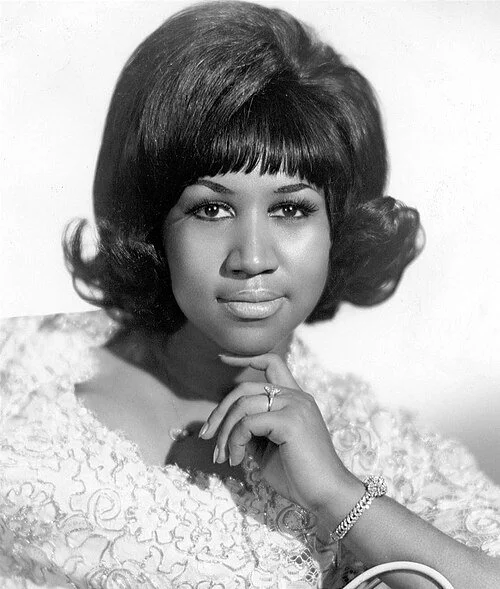
Aretha in 1968, a year after the release of I’ve Never Loved a Man the Way I Love You.
Credit: Atlantic Records via Wikimedia Commons
Hello, I'm Dolly, was released just six months after Aretha's I've Never Loved A Man The Way I Love You. Prior to it's release, Aretha's career was middling. After eight albums, she'd scored a few minor hits forging a name in the jazz and blues club sectors. The caliber of her soprano voice was undeniable but a catalog of well-trodden American jazz and pop standards struggled to vie commercially. With I've Never Loved A Man, she widened her scope beyond the jazz singer archetype producer John Hammond and Columbia had fashioned her into. Like Dolly and her future mentee and surrogate niece, Whitney, Aretha's foundations were in the church. Daughter of the prominent pastor C.L. Franklin she performed in front of congregations at New Bethel Baptist Church as a child. Her very first released album, Songs of Faith was recorded at the church where she sang and played piano at just fourteen-years-old.
Without abandoning the blues spirit of her preceding albums, I've Never Loved A Man, channels the gospel roots of Aretha to their fullest power. The change led to her first number one on the pop charts with her most well known song to-date, "Respect." Her penchant for reinvigorating known songs is still present but she showcased original music that would became the DNA of her sound. The album also included one of her first independent writing credits, the sultry "Dr. Feel Good (Love is a Serious Business)."
Four years later in March 1971, Aretha was big enough to healdine three shows at the historic Fillmore West venue in San Francisco. All three shows were recorded for a live album, released a few months later, and filmed. Backed by King Curtis' band that featured Billy Preston on the organ and a trio of supporting vocalists, the set begins with an up-tempo version of "Respect." Towards the song's end Aretha speaks to the audience asking them to "relax on their soul to us for just a few minutes."
"Just feel good," she encourages, "let it all hang out, every last bit of it." The instructions ring like words I've heard from pastors at the pulpit as they guide their congregation to be imbued with the spirit through praise and worship.
After a few songs, Aretha takes a seat in front of a piano, where she'll remain for the majority of the concert presiding over her flock. She wears an ankle length long-sleeved white dress and her hair is bundled in a wrap, looking as ready to host a late-night church revival as she does performing for her secular audience. Sometimes when encountering media on American music, one may get the sense that the author is doing their due diligence to correctly attribute foundations. There may be an obligatory mention that country and rock, however frequently performed by white people, is indebted to black gospel and blues both which are forged by a medley of religious origins during slavery, before moving on towards the central subject they will cover. For people living outside of regions and experiences where this information is evident, the facts may be transcribed and received as a point of historical trivia that is Important to Know. Listening to Aretha however, one hears the embodiment of how these threads weave together and are fully realized. Coursing through renditions of her own hits at the Fillmore, alongside Simon & Garfunkel's "Bridge Over Troubled Water" and "Eleanor Rigby" from the Beatles, she traces the constellation of popular music in (and beyond) the U.S., charting its many vestiges.
"Does anyone feel like hearing the blues?" she asks before launching into "Dr. Feel Good."
"Sang it!" "Right on now!" Members of the audience call out in encouragement as she sings:
"I don't want nobody / Always / Sittin around me and my man..ain't that right, girls?" she ad-libs to shouts of affirmation in an exchange that echoes the call-and-response of church leader and congregation: Can I get an amen?"
The song's last lines "dear God almighty that man sure makes me feel good," gives way to testimony. The band improvises around Aretha and her piano, matching her rhythm while she espouses the values of looking to heaven when feeling lost and consumed by worry. "If you understand some of what I mean can I hear you say 'yeah'?"
The ending interlude is the perfect introduction to the organ-heavy "Spirit in the Dark." Aretha doesn't make a distinction between pop and the gospel or the spiritual and the secular, from body to soul, it's an organic alignment. She is induced by the spirit—hers, an exhilarated audience, something more almighty, or perhaps as rehearsed. At the climax of "Spirit in the Dark" she stands from the bench as the band revs up in a melody familiar to anyone who has spent a morning sweating in pews, exalting a God most high. (If your mind has been corrupted by discussions of "stomp, clap, hey music" as a mark of irksome late 2000s indie faux-folk, consider that foot stomping / hand clapping is a common marker for traditional gospel.) Aretha twirls across the stage. Dancing, she raises her arms above and out towards the crowd, singing where the spirit leads her.
In a tribute to Aretha after her death, Dolly noted that she "was one of the lucky ones to have seen [her] perform in the very beginning of her career." Did Dolly see the same sort of electrifying performance on display at the Fillmore West— a unification of spirit and soul, transmuting both for widespread appeal? Across her discography, Dolly embraces her own relationship to gospel and spirituality as heard in "Light of a Clear Blue Morning" from 1977's New Harvest…First Gathering. The aptly titled album was her first completely independent from Wagoner, with whom she'd become estranged.
Evoking the classic Americana image of a liberated eagle breaking through bondage to soar high, one senses that the new freedom, though welcomed is also bittersweet. She comforts herself "I can see the light of a clear blue morning / I can see the light of a brand new day." Though secular in meaning, the song, picking up in speed as it approaches joyously hopeful and uplifting end akin to many gospel songs. "Everything's gonna be alright / everything is going to be okay," she declares with a certainty that feels preordained.
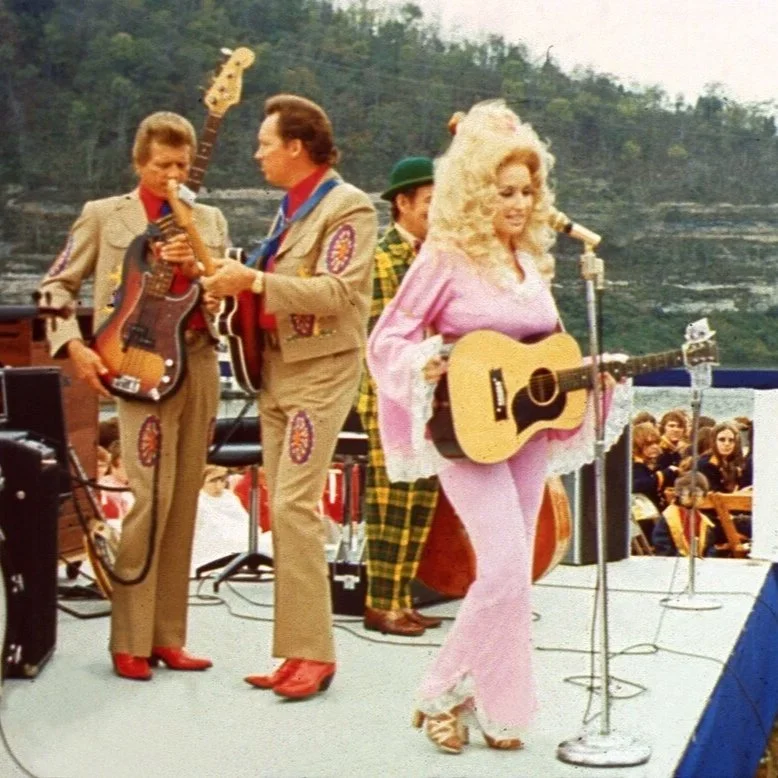
Dolly Parton performing at the dedication of Cordell Hull Dam in Carthage, Tennessee, on October 13, 1973. Sourced via Wikimedia Commons
It's fitting that for all three women—Dolly, Aretha, and Whitney— some of their earliest performances happened in church. Not just for their relationships to faith or associations of divinity, but for the rigor church bands and choirs often provide (if their experiences were at all similar to what I've witnessed of church musicians). They may have endured multiple weekly rehearsals and an emphasis on tight structure for all involved. Solos were not simply given in a reward participation but earned through dedication and proven proficiency.
Dolly once rejected the term "diva," as a way to describe her. "I'm a working girl. I don’t make people bend over backwards," she explained, alluding to the negative connotations of divas as demanding women perennially dissatisfied, prissy and entitled to their glorious comforts. But what girl works harder than a diva? Dolly knew the exertion of labor of looking good—a rotation of wigs, combed and teased to perfection, long polished nails with the acrylic seamlessly fixed to the cuticle, dresses and jumpsuits meant for standing, and heels that elongate and accentuate the calves while maintaining an air of dainty agility. All while giving them a show. For all the grievances about divas, many come to their stages in reverence and worship, venerating the glamorous women who don't just sing like the mere talented but sang like the divinely touched.
Despite her protestations, Dolly was a diva. While some of her peers accepted, however reluctantly, the assumption of a difficult woman that underpins characterizations of diva-dom, she fortified the persona introduced on the Porter Wagoner Show nearly sixty years go. With her celebrated kindness and disarming humor that never quite revealed a clear politic, she was an entity. Outside of music and film she utilized her signatory look. She licensed her image to cookware and fan merch and created Dollyworld, all evidencing her ambitious vision of accumulating vast capital.
Perhaps her trepidation about the diva honorific is understandable given how the perception of an archetype can overtake audience's reception of a performer. Yes, her style was an intentional to ploy to draw eyes but always with the goal to gain ears as well. In recent years, Aretha has been dubbed the Queen of Shade in addition to Soul. "Beautiful gowns" and stories of her dismissing younger and upcoming singers later in her life are frequent points of discussion about the singer, overshadowing at times, the expansiveness of the musicality that altered pop music. Before her death, Whitney once deemed the singular Voice, had in some ways, been reduced to tabloid fodder and a cautionary tale ripe for ridicule. Even with Dolly, much breadth may be given to her lifelong drag performance, her witticisms, or philanthropy, while her stylized guitar-playing—achieved remarkably with her long acrylics—remains under-discussed. Perhaps the reluctance in being named a diva the risk of contortion or caricature, being beloved for what has been or was, a relic who is well-preserved or on the cusp of a hopeful comeback.
Yet from another view, one remembers that a diva is not a title that is bequeathed. One of the tricks of diva-dom is that it may seem granted, like divine right yet she seizes the crown after proving her ability to deliver quintessential bops. She survives the brutality of a public that is skeptical of anyone, but especially women, who have overstayed their welcome by aging. We laud her roots of humility, imagining an unassuming pre-glam girl with undiscovered magic, while relishing and expecting her present opulence. If she must wear a coat of all of our projections, shouldn't she get to call most of the shots? If she's entitled it's because we were first emboldened to know her.
Dolly of course, was known to be an intensely private person. Unlike Whitney and Aretha, she was afforded a separation between her image and the contours of her intimate life. Perhaps this distancing afforded her the space to remain kind and gracious. The boundary was more or less accepted by fans and later, revered even as a growing list of pop stars are chided for avoiding or lamenting the ills of the spotlight. With this barrier intact, Dolly was one of the lasting figures of bipartisan appreciation. From her acts of giving we can catch a glimpse of maybe not her politics per say, but her moral motivations. Donating to research for the Moderna COVID-19 vaccine shows a faith in medical science and care for public health. Her foundation Imagination Library which delivers free books to young children highlights how much she values literacy (her share-cropper father never learned to read). The program also reminds how storytelling was central to her life. I'd guess that an early introduction to reading laid the foundations for her prolific songwriting and imaginative narratives.
Since her death I've seen the sentiment that Dolly was as close as to having an angel on Earth as we may get. It is easy to figure her as a heavenly being, doling out acts of charity with her fluffed out platinum halo. But what a gift to know that she was real. Her primacy in our lives reflects her commitment to creating and to remain connected to the world. Like Aretha and Whitney, her absence highlights a nostalgia for a cultural ubiquity that has long dissolved, if it were ever fully present at all. For better and worse, divas may be the closest thing we have to immortal deities. They live on in retelling of their histories and jokes, in impersonations of their likeness and style, and most crucially in the music.